
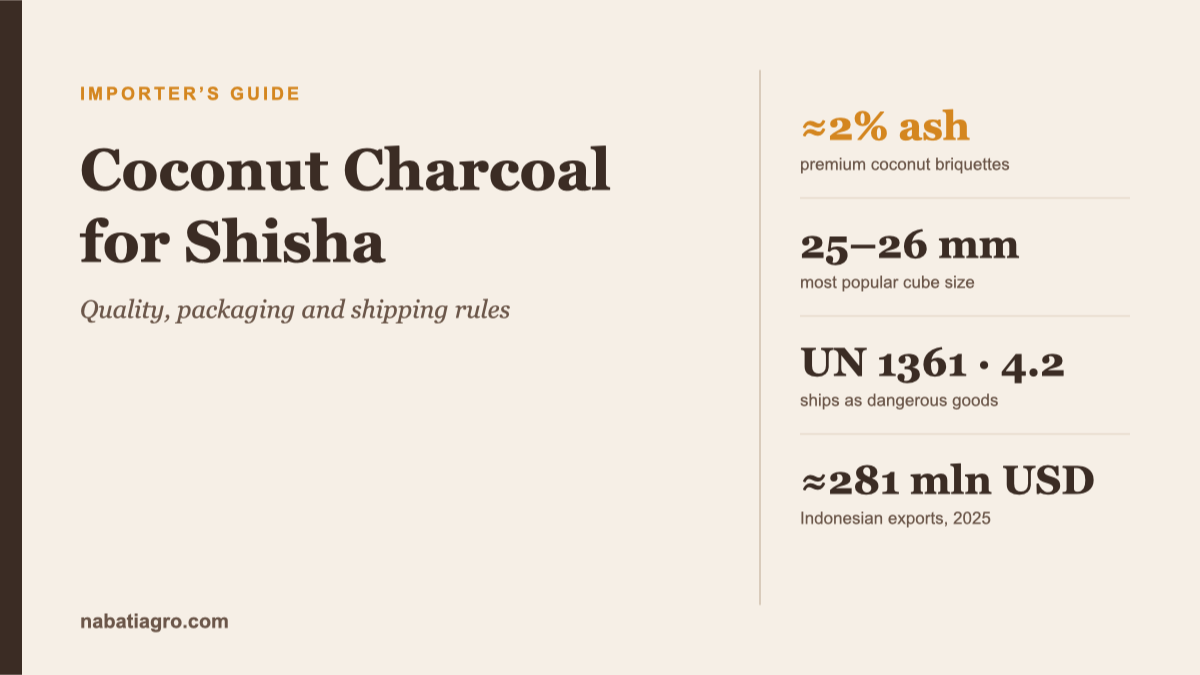
Indonesia is one of the world’s leading producers of coconut shell charcoal, and its shisha briquettes are sold in hookah lounges and shops from the Middle East to Europe. For an importer, the difference between a good and a bad supplier shows up in the details: ash, burn time, smell, packaging and the shipping documents. This guide explains what makes quality shisha charcoal, which parameters to put in the contract, and how the 2025–2026 change in shipping rules affects every buyer.
Why Coconut Shell Charcoal for Shisha
Natural shisha charcoal is made by carbonising coconut shells, grinding the charcoal, mixing it with a natural binder (usually tapioca starch), pressing it into cubes or flats and drying it. Compared with other natural coals it offers:
- low ash that stays light and does not fall into the bowl;
- long, even burn of around two hours for a standard 25 mm cube;
- neutral smell, so it does not change the taste of the tobacco;
- renewable raw material: coconut shells are a by-product of the coconut industry.
Unlike quick-lighting coals, natural coconut briquettes contain no chemical accelerants. They need a burner to light, which is why lounges prefer them.
Quality Parameters to Put in Your Contract
There is no single international standard for shisha charcoal, so buyers agree the specification with the factory. Typical market ranges are:
| Parameter | Premium grade | Standard grade | Why it matters |
|---|---|---|---|
| Ash content | about 2% or less | up to about 2.5–3% | Less ash, cleaner session and less frequent cleaning |
| Fixed carbon | 80% or more | about 75% | More carbon, longer and more stable heat |
| Moisture | below 5% | up to about 6% | Wet briquettes crack, spark and light badly |
| Volatile matter | low, about 10% or less | up to about 15% | Volatiles cause smoke and smell |
| Calorific value | about 7,000–7,500 kcal/kg | about 7,000 kcal/kg | Heat output |
| Burn time (25 mm cube) | about 2 hours or more | about 1.5 hours | How long one coal lasts |
Ask for a certificate of analysis from an independent laboratory and test samples yourself before the first order: burn several cubes, check the ash colour (light grey to white is good), smell and how often the coal cracks.
Shapes and sizes
- Cubes: 25 × 25 × 25 mm and 26 × 26 × 26 mm are the most popular; 22, 27 and 28 mm cubes are also produced;
- Flats: about 25 × 25 × 15 mm, for kaloud-type heat management devices;
- Fingers and hexagons: for specific brands and markets.
Packaging and Private Label
Shisha charcoal is usually packed in 1 kg inner bags or boxes inside a master carton of 10 or 20 kg. Many importers sell under their own brand: the factory prints the importer’s design on inner boxes and cartons, which requires artwork approval and a minimum order per design. Packaging must protect the charcoal from moisture, because damp coal loses quality and can become a safety risk in transit.
Shipping Rules: Charcoal Is Now Dangerous Goods
This is the most important recent change for importers. Charcoal can self-heat and has caused fires on container ships. Under amendment 42-24 of the IMDG Code, packaged charcoal (UN 1361, class 4.2) can no longer be shipped as non-dangerous goods just because it has passed the UN N.4 self-heating test. The amendment could be applied voluntarily from 2025 and is mandatory from 1 January 2026, and major lines such as Hapag-Lloyd have required a Dangerous Goods Declaration for all charcoal shipments since April 2025.
In practice this means:
- shipments are booked as dangerous goods, with a DG declaration and correct marking of cartons and containers;
- the self-heating test still matters for the packing group and for carrier acceptance;
- charcoal must be cooled and weathered after production before packing, and containers must be loaded with headspace for ventilation;
- freight is higher and not every carrier or route accepts charcoal, so booking needs to be planned early.
Always confirm the current requirements with your forwarder and shipping line before booking.
Indonesia’s Coconut Charcoal Exports
According to UN Comtrade data, Indonesia exported coconut shell charcoal (HS 4402.20) worth about 281 million USD in 2025, about 236,000 tonnes. The main buyers are in the Middle East, especially Saudi Arabia, the UAE and Iraq, followed by other markets in Asia, Europe and the CIS. Indonesia’s advantage is a large and stable supply of coconut shells from Java, Sumatra and Sulawesi.
Step-by-Step: Importing Shisha Charcoal from Indonesia
- Define the product: size, shape, quality parameters, packaging and brand.
- Request samples and lab reports, and test them in real use.
- Agree the contract: specification, packaging, price basis (FOB or CFR/CIF), payment terms and lead time.
- Approve artwork for private label packaging.
- Production and pre-shipment inspection: check quality, moisture, weight and packing before loading.
- Dangerous goods shipping: DG booking, declaration and container loading under IMDG rules.
- Import clearance: commercial invoice, packing list, bill of lading, certificate of origin and the certificates your country requires.
Buy Shisha Charcoal from Indonesia
PT. Nabati Agro Lestari supplies coconut shell charcoal for shisha from Indonesia. Tell us the size, quality grade, packaging, volume and destination, and our team will prepare an offer. More about Indonesian export products: What does Indonesia export?
Request a Quote Chat on WhatsApp
Sources: BIMCO and Hapag-Lloyd (IMDG rules for charcoal); Britannia P&I (safe carriage of charcoal); UN Comtrade data via coconutcharcoal.org (export figures); laboratory test results and producer specifications (quality ranges). Quality figures are typical market ranges, not a standard.