
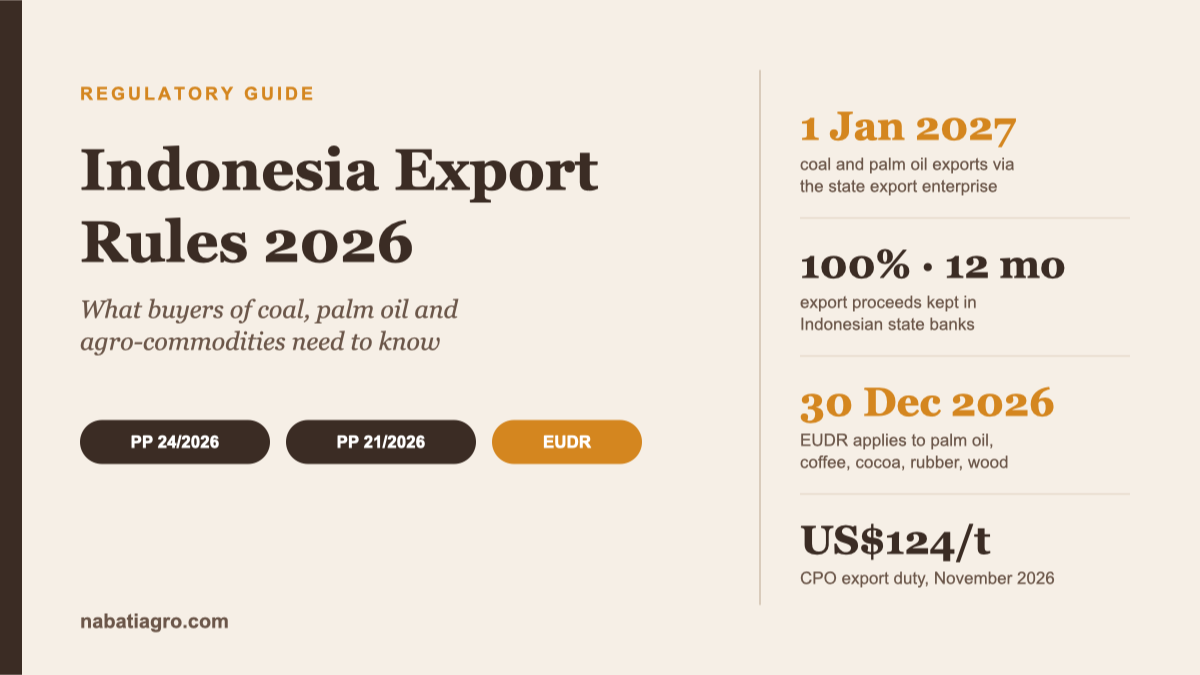
2026 is the biggest change to Indonesia’s export rules in years. Coal and palm oil are moving to a state-controlled export channel, export proceeds must stay in Indonesian state banks for a year, a coal export duty is on the table, and the EU Deforestation Regulation (EUDR) starts to apply to palm oil, coffee, cocoa, rubber and wood at the end of the year. For a buyer, these rules affect who signs the contract, how payment works, which documents arrive with the cargo and what the final price includes. This guide summarises what has changed, what is still uncertain and what to check with your supplier.
1. State-Controlled Exports for Coal and Palm Oil (PP 24/2026)
Government Regulation PP 24/2026 on the governance of strategic natural resource exports took effect on 1 June 2026. It covers coal, palm oil and ferro alloys, and the government can add other commodities later.
- Transition period (1 June – 31 December 2026): existing exporters keep their licences, but must report exports and submit documents to the designated state-owned export enterprise. The enterprise is linked to the sovereign fund Danantara.
- From 1 January 2027, or earlier if the government decides: these commodities may be exported only through the state export enterprise, which can act as the exporter or as the sole intermediary and sets export prices and margins.
- Existing contracts: contracts signed before 1 June 2026 are subject to evaluation by the state exporter. Lawyers advise buyers to expect possible review, restructuring or novation of offtake agreements.
The Ministry of Trade issued three implementing regulations, all effective 1 June 2026:
| Regulation | Scope | Key points for buyers |
|---|---|---|
| Permendag 15/2026 | Coal, lignite and peat (HS 2701–2703) | Existing registered exporter permits and surveyor reports stay valid until 31 December 2026. |
| Permendag 16/2026 | CPO, RBD palm oil, RBD palm olein, used cooking oil and palm oil residues | Export approvals stay linked to the Minyakita domestic market obligation; exporters report to the state exporter during the transition. |
| Permendag 17/2026 | Ferro alloys (HS 7202) | Not covered by our product range. |
What it means for you: from 2027 your counterparty for coal and covered palm products may be the state export enterprise, not the producer or trader. Ask your supplier how existing and new contracts will be handled, who will issue the commercial invoice, and how prices and payment terms will be set after the transition. Palm kernel shells are not named in the published summaries of Permendag 16/2026, but confirm the HS code of your product with the supplier.
2. Export Proceeds Must Stay in Indonesia (PP 21/2026)
Under PP 21/2026, effective 1 June 2026, exporters of natural resources, including mining and plantation products, must place 100% of their export proceeds (DHE SDA) in special accounts at Indonesian state-owned banks for at least 12 months, and may convert no more than 50% into rupiah. Interest on these placements is exempt from income tax. Some mining exporters linked to investors from listed countries can qualify for lighter rules; in November 2026 the EU, Japan and South Korea were added to that list.
What it means for you: the rule applies to the exporter, not the buyer, but it ties up the exporter’s working capital and can affect payment terms. Expect suppliers to ask for payment into an account at a state-owned Indonesian bank and to prefer letters of credit or advance payment over long credit terms.
3. Coal: HBA Pricing, DMO and a Possible Export Duty
- HBA-linked export prices: since 1 March 2025, Indonesian coal export sales must reference the government benchmark price HBA, which is now published twice a month. Contracts based purely on international indices need an HBA reference.
- Domestic market obligation (DMO): producers must supply part of their output to domestic power plants and industry. DMO compliance affects export quotas and can tighten supply of some grades.
- Export duty: the government announced a coal export duty of about 1–5% depending on calorific value, first planned for 1 January 2026 and later for April 2026. As of early November 2026 we have not found a published implementing regulation, so confirm the status before you fix a long-term price.
More on prices, markets and FOB/CIF terms: Steam Coal Market 2026.
4. Palm Oil: Reference Price, Duty and Levy
Each month the Ministry of Trade sets a CPO reference price, which determines the export duty and the export levy. For November 2026 the reference price is US$978.90 per tonne, down 6.07% from October. The export duty fell to US$124/t from US$178/t, and the levy stays at 12.5% of the reference price, about US$122.36/t. Total export charges fell by about 20%.
These charges are built into FOB prices, so a buyer feels every monthly change. Palm oil export policy is also tied to domestic priorities: the Minyakita cooking oil programme and the government’s push for higher biodiesel blending, which reduces the volume available for export. Latest market drivers: Palm Oil Market Update, November 2026.
5. EUDR: Palm Oil, Coffee, Cocoa, Rubber and Wood into the EU
The EU Deforestation Regulation applies from 30 December 2026 for large and medium operators and from 30 June 2027 for micro and small operators. It covers oil palm, cocoa, coffee, rubber, wood (including plywood), cattle and soya, and many products made from them. Before placing these goods on the EU market, the EU operator must show that they:
- were produced on land not deforested after 31 December 2020;
- were produced legally under the laws of the country of production;
- can be traced to the plots where they were grown, with geolocation data.
Indonesia’s challenge is smallholders: most of its coffee, cocoa and rubber comes from small farms, many of which are not yet mapped or registered. For EU buyers, the practical steps are to agree now which geolocation and legality documents the supplier will provide, and to plan time for due diligence before the first shipment under the new rules.
Product guides: Indonesian coffee, cocoa, natural rubber, plywood, palm oil.
6. IEU-CEPA: The Indonesia–EU Trade Agreement
Indonesia and the EU concluded negotiations on the Comprehensive Economic Partnership Agreement (IEU-CEPA) in September 2025. At the time of writing, signing was expected in late 2026 and implementation is targeted for early 2027, after ratification by both sides. The agreement will cut or remove EU import duties on many Indonesian goods. Coffee and cocoa beans and natural rubber already enter the EU at zero duty, so for them EUDR compliance matters more than tariffs.
7. Imports into Indonesia: Halal Certification
For buyers in Indonesia, the Halal Product Assurance law makes halal certification mandatory for most food and beverages sold in the country, and the transition for many imported products ended on 17 October 2026. This is relevant to ingredients such as skimmed milk powder. Foreign halal certificates must be recognised and registered with BPJPH, Indonesia’s halal agency. Reports differ on extensions for some imported categories, so check the current BPJPH rules for your product. Market overview: Milk Powder Market 2026.
Which Rules Apply to Which Product
| Product | State export channel (PP 24/2026) | Export proceeds (PP 21/2026) | Other rules |
|---|---|---|---|
| Steam coal | Yes | Yes | HBA pricing, DMO, planned export duty |
| RBD palm oil, olein, CPO | Yes | Yes | Monthly duty and levy, Minyakita DMO, EUDR |
| Palm shortening | Check HS code | Check with supplier | EUDR for EU buyers |
| Palm kernel shells | Not named in published lists | Check with supplier | Sustainability certificates for EU biomass buyers |
| Coffee, cocoa, natural rubber | No | Plantation products: check with supplier | EUDR; IEU-CEPA |
| Plywood | No | Check with supplier | EUDR; timber legality documents |
| Coconut shell charcoal | No | Check with supplier | Dangerous goods shipping rules (IMDG) |
| Skimmed milk powder (imports into Indonesia) | No | No | Halal certification and registration |
Buyer’s Checklist for 2026–2027
- Ask who will be the seller and who will issue the invoice from 2027 for coal and palm oil.
- Review existing offtake contracts for change-of-law, novation and price-adjustment clauses.
- Confirm payment instructions and the bank: proceeds must go to Indonesian state-owned banks.
- For coal, agree how the HBA reference and any future export duty are reflected in the price.
- For palm oil, agree how monthly changes in duty and levy are passed through.
- For EU deliveries, agree EUDR documents: geolocation, legality and due-diligence data.
- For food imports into Indonesia, confirm halal certification and BPJPH registration.
How Nabati Agro Can Help
PT. Nabati Agro Lestari follows Indonesian regulatory changes and keeps buyers informed, so contracts, documents and payments stay compliant. Tell us the product, volume and destination, and we will explain which rules apply and prepare an offer.
Request a Quote Chat on WhatsApp
Sources: Rajah & Tann Asia, PP 24/2026; Palm Oil Magazine, Permendag 15–17/2026; Pajakku, PP 21/2026; ANTARA, DHE SDA exemptions; Petromindo, coal export duty; Palm Oil Magazine, November 2026 CPO reference price; The Jakarta Post, EUDR and smallholders; AHK Indonesia, IEU-CEPA; ChemLinked, halal certification. Status as of 10 November 2026. This article is for information only and is not legal advice; check the current official texts before making decisions.