
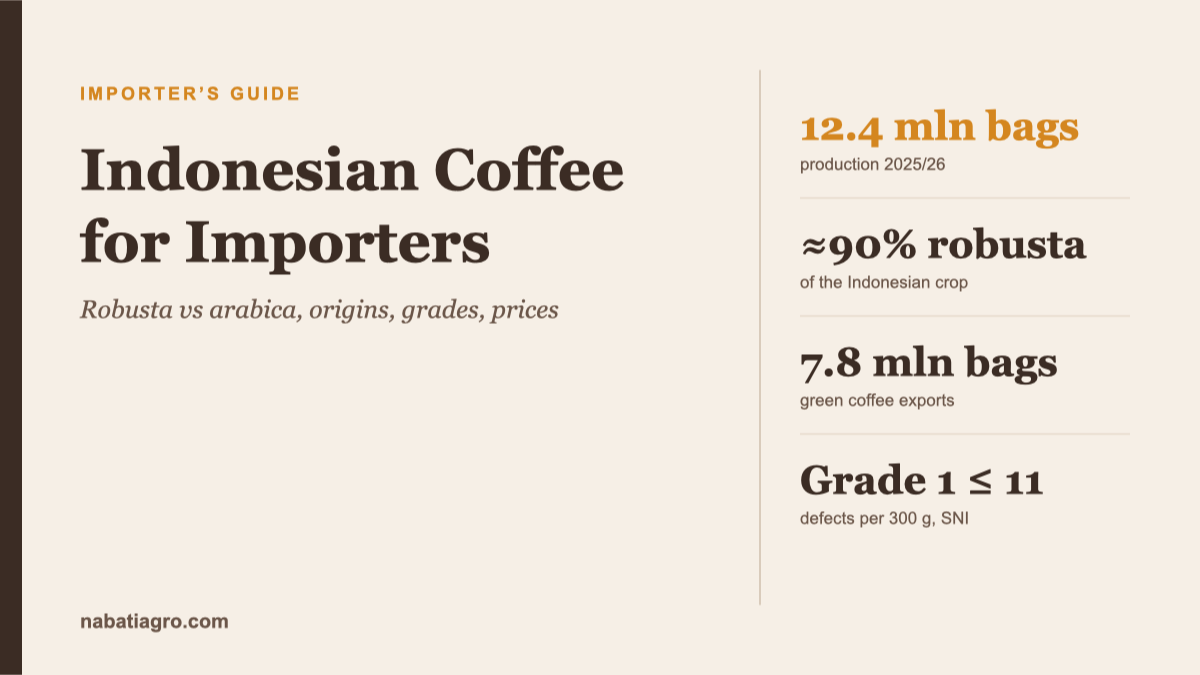
Indonesia is one of the world’s largest coffee producers and the second-largest robusta supplier to Europe. From the robusta farms of Lampung to the arabica highlands of Aceh, Sumatra and Sulawesi, it offers green coffee for every segment, from instant coffee to specialty roasters. This guide for importers covers production, the main origins, robusta versus arabica, the Indonesian grading system, harvest timing, prices and the export process.
Indonesian Coffee at a Glance
| Production, 2025/26 | about 12.4 million 60-kg bags (about 11 million robusta, 1.37 million arabica) |
|---|---|
| Production forecast, 2026/27 | about 11.4 million bags, −8% after heavy rains in robusta areas |
| Green coffee exports, 2025/26 | about 7.8 million bags |
| Share of world green coffee trade | about 5% |
| Main robusta region | southern Sumatra (Lampung, South Sumatra, Bengkulu): 80–90% of robusta output |
| Market year | April–March |
Production and Exports
Indonesia’s 2025/26 crop was a strong one: about 12.4 million bags, up sharply on the year, and green coffee exports rose to about 7.8 million bags. For 2026/27 the USDA expects a smaller crop of about 11.4 million bags because excessive rain disrupted flowering in southern Sumatra and parts of Java. Robusta makes up almost 90% of production, arabica the rest.
Indonesians also drink a lot of their own coffee: domestic consumption is close to 4.8 million bags a year, so only part of the crop is available for export.
Robusta vs Arabica
| Robusta | Arabica | |
|---|---|---|
| Share of Indonesian production | almost 90% | about 10% |
| Where it grows | Lowlands: Lampung, South Sumatra, Bengkulu, East Java | Highlands: Aceh (Gayo), North Sumatra, Toraja, Kintamani (Bali), Flores, Java |
| Taste | Strong, bitter, full body, high caffeine | Sweeter, more acidity and aroma |
| Typical use | Instant coffee, espresso blends, mass market | Specialty and premium roasts, single origin |
| Price benchmark | ICE London robusta futures (USD/tonne) | ICE New York arabica futures (US cents/lb) |
Famous Indonesian Origins
- Sumatra Mandheling and Lintong (North Sumatra): full-bodied, earthy arabica, often wet-hulled.
- Gayo (Aceh): clean, complex highland arabica, widely available with organic and fair trade certification.
- Java: historic origin; arabica from the Ijen plateau and robusta from East Java.
- Toraja and Kalosi (Sulawesi): balanced arabica with spicy notes.
- Kintamani (Bali) and Flores Bajawa: smaller specialty origins.
- Lampung robusta: the volume heart of Indonesian robusta exports.
Wet-hulling: the Indonesian process
Much Indonesian arabica is processed by wet-hulling (giling basah): the parchment is removed while the beans are still wet, then the beans are dried. This gives the deep body and earthy, herbal profile typical of Sumatra. Washed and natural processes are also used, especially for specialty lots.
Indonesian Grading: SNI 01-2907-2008
Indonesian green coffee is graded under the national standard SNI 01-2907-2008 by the number of defects in a 300 g sample. Each defect type has a weight: for example, one full black bean counts as 1 defect, a partial black bean as ½.
Export lots are usually Grade 1 to Grade 4. For robusta the market also uses the “EK” (export quality) designation, such as EK1 for top export robusta. Other key parameters in a contract are:
- moisture: usually 12.5% maximum (some robusta contracts allow 13%);
- screen size: for example, screen 15–19 for robusta;
- foreign matter and insect damage;
- cup quality for arabica and fine robusta.
Always confirm the exact limits in the contract and with a pre-shipment sample.
Harvest Timing
Indonesia harvests coffee over a long season. The main robusta harvest in southern Sumatra and Java takes place in the middle of the year, roughly from April to August, which is why the market year starts in April. Arabica in the northern Sumatra highlands is harvested over a longer period with a main crop in the second half of the year. Shipments of new-crop robusta usually peak in the third quarter.
Prices in 2026
Green coffee is priced against the futures markets plus or minus a differential for origin, grade and quality. In early November 2026 the ICE London robusta futures traded around 3,260 USD per tonne, close to their lowest level since March 2024, while ICE arabica futures were around 2.80 USD per pound. Prices remain well above long-term averages, which has squeezed roaster margins and pushed some buyers toward robusta and lower grades.
Who Buys Indonesian Coffee
Europe is the largest destination: in 2025/26 exports there rose by more than 70% to about 2.4 million bags, led by Belgium and Germany, and about 85% of shipments to Europe are robusta. Other important buyers include the United States, which takes mainly arabica, Egypt, Malaysia, Japan, Russia and Viet Nam.
Export Documents
- sales contract with grade, moisture, screen size and price basis;
- commercial invoice and packing list;
- bill of lading;
- phytosanitary certificate;
- certificate of origin and ICO certificate of origin;
- quality and weight certificates from an independent surveyor;
- fumigation certificate when required by the importing country;
- organic or other sustainability certificates for certified lots, plus geolocation and due-diligence information for buyers in the European Union as the EU Deforestation Regulation (EUDR) is phased in.
Green coffee is shipped in 60 kg jute bags or in bulk container liners, usually about 19–21 tonnes per 20′ container.
Buyer’s Checklist
- Choose the type and origin: robusta or arabica, region and process.
- Agree grade, defect count, moisture and screen size.
- Approve a pre-shipment sample and cup it.
- Fix the price: outright or as a differential to ICE futures.
- Agree packing, shipment period, documents and payment terms.
Buy Coffee Beans from Indonesia
PT. Nabati Agro Lestari supplies green coffee beans and coffee and cocoa products from Indonesia. Tell us the type, grade, volume and destination, and our team will prepare an offer.
Request a Quote Chat on WhatsApp
Sources: USDA FAS, Indonesia Coffee Annual 2026; Daily Coffee News (2026/27 forecast, regions, Europe); Daily Coffee News (2025/26 exports, destinations); SNI 01-2907-2008 grading summary; Barchart (robusta futures). This article is for information only and is not investment advice.