
Europe needs more biomass than its forests can sustainably supply, and palm kernel shells (PKS) are one of the fuels helping to fill the gap. Coal phase-outs, the EU’s renewable energy targets and a tight wood pellet market keep demand for solid biomass high. Here is the outlook for PKS in Europe as of November 2026: what drives demand, where the buyers are, and what suppliers need to succeed.
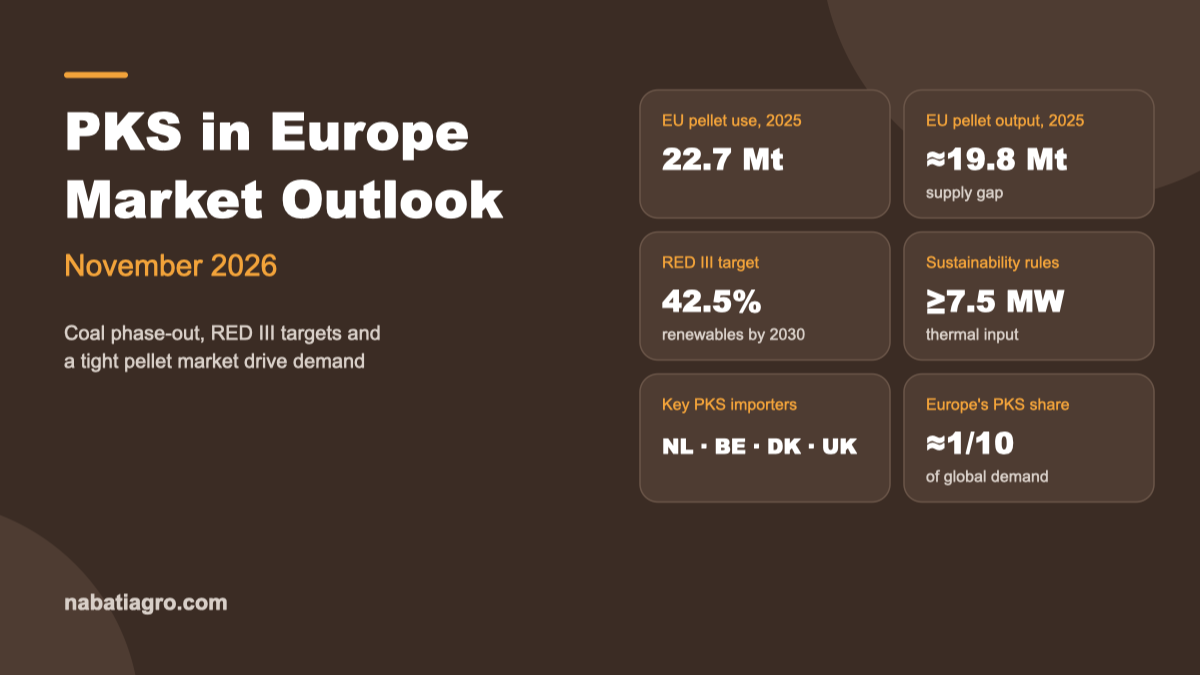
European Biomass Market: Key Numbers
| EU wood pellet consumption, 2025 | 22.7 million tonnes, with further growth expected in 2026 |
|---|---|
| EU wood pellet production, 2025 | about 19.8 million tonnes: demand outpaces local supply |
| EU renewable energy target | 42.5% of energy consumption by 2030 (RED III) |
| Sustainability rules apply to | solid biomass plants from 7.5 MW thermal input (previously 20 MW) |
| Main European PKS importers | the Netherlands, Belgium, Denmark, the United Kingdom |
| Europe’s share of global PKS demand | roughly one tenth; most PKS goes to Japan and South Korea |
What Drives Demand for PKS in Europe
1. Coal phase-out and co-firing
European utilities are closing coal plants or converting them to biomass. Where coal units keep running, co-firing biomass cuts emissions. Poland is a clear example: coal still produced about 52% of its electricity in 2025, and utilities such as Enea and Energa are upgrading coal units to co-fire biomass from 2026 to stay below the EU’s 550 g CO2/kWh limit for capacity payments.
2. A tight wood pellet market
The EU consumed 22.7 million tonnes of wood pellets in 2025 but produced only about 19.8 million tonnes. Local production is not keeping up because sustainable woody biomass is limited. That gap makes imported and non-wood biomass, including agricultural residues such as PKS, more relevant for large buyers.
3. EU renewable energy targets
The revised Renewable Energy Directive (RED III) sets a 42.5% renewable share in EU energy consumption by 2030. Sustainable solid biomass counts toward this target, and it can be used in existing boilers, which makes it attractive for power and heat producers.
4. Industrial heat and combined heat and power
Nearly half of EU pellet consumption comes from large industrial users, mainly power and heat plants in markets such as the Netherlands and Denmark. These are the same buyers that already import PKS for co-firing and dedicated biomass plants, as they have done for more than ten years.
Challenges for PKS Suppliers
5. Sustainability certification
Under RED III, biomass used in plants from 7.5 MW of thermal input must meet EU sustainability and greenhouse-gas savings criteria to count toward targets and qualify for support. PKS is a processing residue of the palm oil industry, so it needs certification schemes that cover agricultural residues, such as ISCC EU or SURE, with full traceability back to the mill.
6. Competition with pellets and boiler compatibility
Most European plants were designed or converted for wood pellets. PKS must prove itself in test burns and compete on delivered price per unit of energy. Its advantages are a high calorific value and the fact that it is a by-product rather than a purpose-grown fuel.
7. Logistics and consistent quality
PKS travels from Southeast Asia to European ports in bulk vessels. Utilities look for suppliers who can guarantee volumes, keep moisture and impurities within specification, and provide independent inspection at loading.
Bottom Line
Europe remains a smaller PKS market than Japan or South Korea, but it is a stable one with long-term drivers: coal phase-outs, RED III targets and a structural shortage of local wood biomass. The winners will be suppliers who offer certified, traceable PKS in large, consistent volumes at a price that competes with wood pellets.
Buy Palm Kernel Shells from Indonesia
PT. Nabati Agro Lestari supplies palm kernel shells and other biomass fuels from Indonesia to buyers worldwide. Tell us the volume, specification and discharge port, and our team will prepare an offer.
Request a Quote Chat on WhatsApp
Sources: USDA FAS, EU Wood Pellets Annual 2026 (pellet consumption); Global Wood Markets Info (pellet production); SURE (RED III thresholds); Hawkins Wright (European PKS imports); Forum Energii (Poland’s power mix); Argus Media (Polish co-firing).