
Steam coal still generates a large share of the world’s electricity, and its seaborne trade moves more than a billion tonnes a year. In 2026 the market has turned up again: gas price shocks, Indonesia’s tighter supply policy and record power demand in Asia have lifted prices, while the long-term energy transition keeps reshaping who buys and who sells. This in-depth review covers prices, the main exporters and buyers, how coal deals are structured on FOB, CFR and CIF terms, government regulation and the outlook for 2026–2027.
Steam Coal Market at a Glance
| Newcastle 6,000 kcal/kg NAR, FOB | 144.45 USD/t on 5 Nov 2026, about +30% year on year |
|---|---|
| Indonesia 4,200 kcal/kg GAR, FOB | 66 USD/t at the end of August 2026, up from 45 USD/t at the start of the year |
| Global thermal coal trade, 2025 | about 1.11 billion tonnes |
| Largest exporter | Indonesia: 517 Mt of thermal coal in 2025 |
| Largest importers | China (325 Mt seaborne thermal coal in 2025) and India (167 Mt) |
| Fastest-growing region | Southeast Asia: 156 Mt in 2025, about 164 Mt expected in 2026 |
What Is Steam Coal?
Steam coal, also called thermal coal, is coal burned to raise steam in power plants, cement kilns and industrial boilers. It differs from coking (metallurgical) coal, which is used to make steel. Steam coal is traded mainly by calorific value (CV), measured in kilocalories per kilogram:
- GAR (gross as received) is the standard basis for Indonesian coal;
- NAR (net as received) is used for Australian, South African and other benchmarks. The same coal shows a lower number on an NAR basis than on GAR.
Besides CV, buyers specify total moisture, ash, sulfur, volatile matter, Hardgrove grindability and size. Low-CV coal (around 3,400–4,200 GAR) is cheap per tonne and is bought mainly by plants designed for it in China, India and Southeast Asia. High-CV coal (5,800–6,000 NAR and above) commands premium prices from Japan, Korea and Taiwan.
Prices in 2026: Back on the Rise
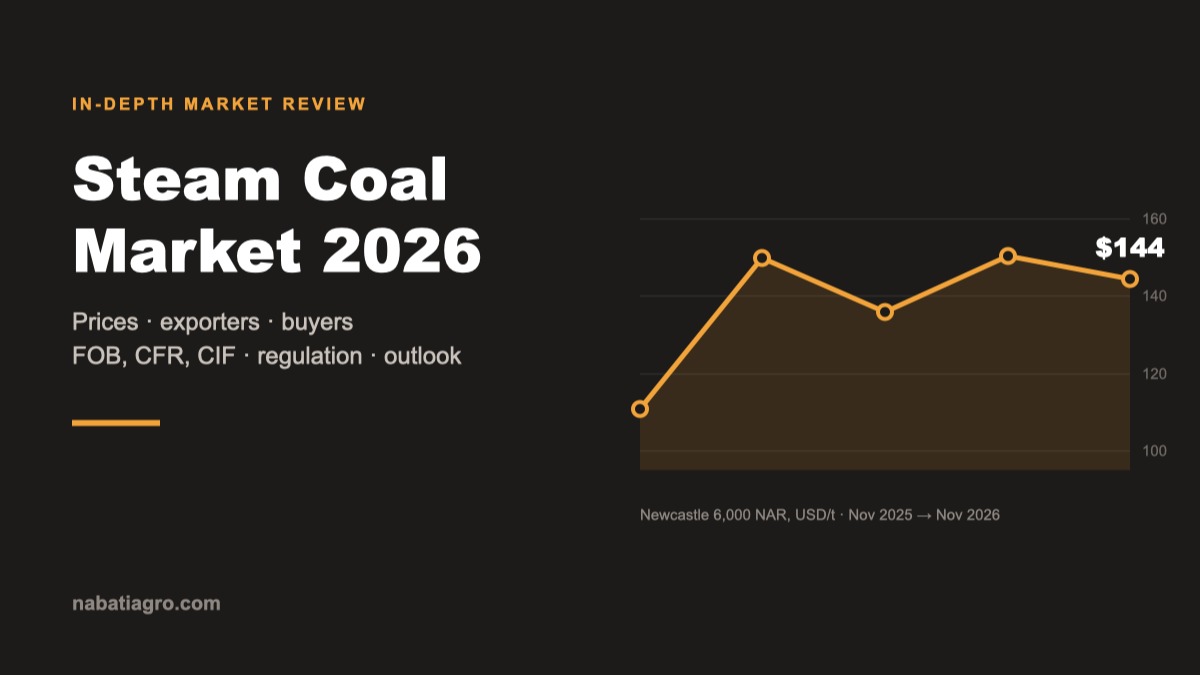
After falling close to production costs in late 2025, prices recovered through 2026. The Newcastle benchmark reached about 150 USD/t in the first half of the year, eased to 136 USD/t in late August and climbed back to around 150 USD/t in mid-October. On 5 November 2026 it stood at 144.45 USD/t, roughly 30% higher than a year earlier.
The main drivers were:
- Middle East conflict: the conflict that broke out at the end of February 2026 pushed up gas prices and made coal more competitive in power generation, especially in Japan and Korea.
- Indonesian policy: lower production quotas and export-related measures added upward pressure, mainly on low-CV coal.
- Supply disruptions: a mining accident in Shanxi reduced Chinese output, and Colombia’s Cerrejón mine declared force majeure on 1 June 2026 after rail blockades.
- Weather: heat in Asia lifted power demand.
Low-CV Indonesian coal gained the most in percentage terms: the 4,200 GAR price rose from 45 to 66 USD/t between January and August 2026, almost +50%. In Europe, ARA prices were around 130 USD/t in the first half of 2026, with much higher volatility after March.
Main Exporting Countries
Indonesia
Indonesia is the world’s largest thermal coal exporter, with 517 Mt in 2025 and about 495 Mt expected in 2026. Most of its coal is low and medium CV from Kalimantan and Sumatra, shipped by barge from river jetties to mother vessels at anchorage. The 2026 decline reflects lower production quotas set by the government.
Australia
Australia is the second-largest exporter (about 209 Mt in 2025 and 216 Mt expected in 2026) and the main source of high-CV coal. Its Newcastle index is the price benchmark for Asia.
Russia
Russia exports about 130 Mt of thermal coal a year, redirected mainly to Asia since European sanctions.
South Africa
South Africa ships about 70 Mt a year from Richards Bay, mainly to India, Pakistan and other Asian markets.
Colombia and others
Colombia exported 45 Mt in 2025, its lowest level since 2003, as European demand fell. Mongolia is increasing rail exports to China, and the United States remains a smaller, swing supplier.
Main Markets: Who Buys Steam Coal
China
China is the largest importer, with 325 Mt of seaborne thermal coal in 2025, but its purchases are highly price-sensitive because domestic production can quickly replace imports. The IEA expects about 310 Mt in 2026.
India
India imported 167 Mt in 2025. Strong domestic production is reducing import needs, and the IEA expects about 160 Mt in 2026. India remains a key market for Indonesian and South African coal.
Japan, Korea and Taiwan
These markets buy mainly high-CV coal under long-term contracts. In 2026 higher gas prices increased coal burn: Japanese imports are expected to stay firm at about 124 Mt, and Korean imports to rise by more than 10%.
Southeast Asia
Southeast Asia is the fastest-growing market, from 156 Mt in 2025 to about 164 Mt in 2026, driven by new coal-fired capacity and rising power demand. Viet Nam alone is expected to import 62 Mt, up from 55 Mt. The Philippines and Malaysia are also major buyers of Indonesian coal.
Europe and Türkiye
European imports are in structural decline as coal plants close. Türkiye remains a sizeable buyer, with about 30 Mt expected in 2026.
For Indonesian coal specifically, China and India remain the two largest markets, followed by the Philippines (about 39 Mt in 2025), Japan, Korea, Viet Nam and Malaysia.
How Steam Coal Deals Work: FOB, CFR and CIF
Seaborne coal is sold under Incoterms 2020. The choice of term decides who arranges and pays for the ship and insurance, and where the risk passes from seller to buyer.
| Term | Seller pays | Buyer pays | Risk passes to buyer |
|---|---|---|---|
| FOB (Free on Board) | Mining, trucking, barging, loading onto the vessel | Ocean freight, insurance, unloading | When coal is loaded on board at the loading port |
| CFR (Cost and Freight) | Everything under FOB plus ocean freight | Insurance, unloading | At loading, although the seller pays freight to destination |
| CIF (Cost, Insurance and Freight) | Everything under CFR plus marine insurance | Unloading, import duties | At loading; the buyer is covered by the seller’s insurance |
FOB barge and FOB mother vessel in Indonesia
Indonesian coal is often sold either FOB barge, where the buyer takes over coal on the barge at the jetty and arranges transshipment, or FOB mother vessel (FOB MV), where the seller also handles barging and transshipment by floating crane or vessel gear onto the ocean-going ship at anchorage. FOB MV is the standard for most international buyers.
Typical steps of a deal
- Enquiry and offer: the buyer sends specification (CV basis, moisture, ash, sulfur), volume, laycan, discharge port and term; the seller offers a price, fixed or linked to an index.
- Pricing: contracts are often index-linked: Newcastle for high-CV coal, the Indonesian Coal Index (ICI) for Indonesian grades, plus a premium or discount. In Indonesia, sales may not be priced below the government reference price (HBA-based).
- Contract: sets quality ranges, price adjustment and rejection limits, laycan, loading rate, laytime, demurrage and despatch, and the dispute resolution forum.
- Payment security: usually an irrevocable letter of credit (L/C) at sight, sometimes a standby L/C or partial telegraphic transfer.
- Vessel nomination: under FOB the buyer nominates the vessel; under CFR and CIF the seller charters it.
- Loading and inspection: an independent surveyor (for example Sucofindo, Carsurin, SGS or Intertek) takes samples and issues certificates of sampling and analysis and of weight, usually by draft survey.
- Documents: bill of lading, certificate of analysis, certificate of weight, certificate of origin (Form E for China or Form AI for India to claim preferential tariffs), commercial invoice and export declaration.
- Settlement: the final price is adjusted for actual CV and other parameters according to the contract formula.
Government Regulation
Indonesia
As the largest exporter, Indonesia’s rules move the whole market:
- Production quotas (RKAB): the government cut 2026 production quotas to roughly 600 Mt, down from more than 800 Mt approved for 2025, to support prices.
- Domestic Market Obligation (DMO): producers must sell 25% of their output to the domestic market; coal for power plants is capped at 70 USD/t.
- Reference price (HBA): since 1 March 2025 the HBA-based reference price is the minimum for coal sales, including exports. It is revised twice a month and also drives royalty rates.
- Export proceeds: exporters of natural resources must keep export proceeds (DHE SDA) in Indonesian banks for a set period.
- Centralised exports (DSI): from 1 June 2026 the state-linked company PT Danantara Sumberdaya Indonesia started handling exports of coal, palm oil and ferroalloys, with a transition period until 31 August 2026. Its final role in coal contracts is still evolving, and some buyers have postponed shipments while waiting for clarity.
- No new export curbs: in June 2026 the energy ministry said no additional export restrictions were under consideration.
Importing countries
Buyers’ policies matter as much. The EU is phasing out coal power and puts a price on CO2 emissions through its emissions trading system. China and India use domestic production targets and trade policy to balance imports, and India’s goal of cutting coal imports already shows in lower volumes. In Japan and Korea, energy security after the 2026 gas shock is slowing the shift away from coal in the short term.
Outlook for 2026–2027
- Volumes: the IEA expects seaborne thermal coal demand to ease slightly, from 1,074 Mt in 2025 to about 1,062 Mt in 2026, and overall coal trade in 2027 to return to around 2025 levels.
- Regional shift: demand is moving from China, India and Europe to Southeast Asia, Japan and Korea in the short term.
- Prices: high gas prices and Indonesian supply discipline support prices, but weaker Chinese demand and a possible easing of gas markets are downside risks.
- Policy risk: Indonesia’s export centralisation and quota decisions remain the biggest single source of uncertainty for buyers of Indonesian coal.
What It Means for Buyers
Buyers should secure supply with reliable producers before the new quota year, prefer index-linked pricing with clear quality adjustment formulas, insist on independent surveyor certificates at loading, and follow Indonesian regulatory changes closely, especially around DSI and the HBA reference price.
Buy Indonesian Steam Coal
PT. Nabati Agro Lestari supplies Indonesian steam coal from GAR 3,200 to 6,500 kcal/kg from mines in Kalimantan and Sumatra, FOB mother vessel, with up to 70,000 MT per month under long-term contracts and independent surveyor inspection before loading.
Request a Quote Chat on WhatsApp
Sources: IEA Coal Mid-Year Update 2026, trade and prices; Trading Economics (Newcastle, 5 Nov 2026); Kalkine; APBI-ICMA (Indonesian export destinations); Jakarta Globe (DSI); Energynews (HBA). This article is for information only and is not investment advice.