
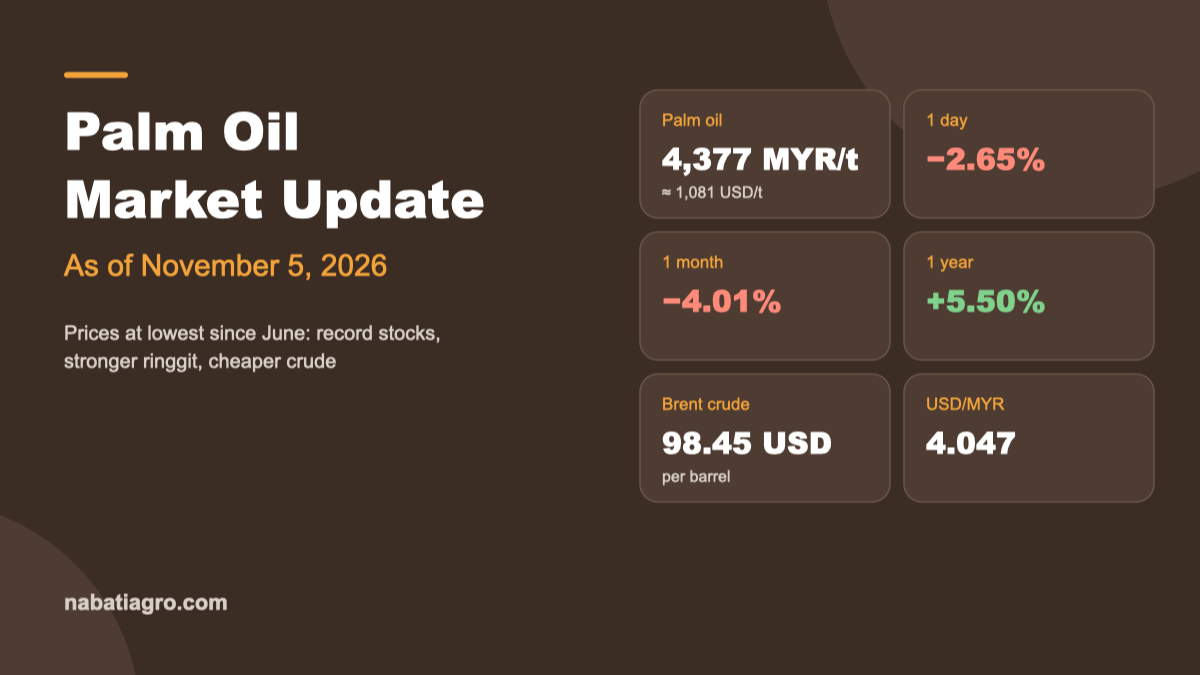
Malaysian crude palm oil futures fell to their lowest level since June in early November 2026. Record Malaysian stocks, a stronger ringgit and cheaper crude oil are weighing on prices, while strong Indian buying and Indonesia’s B50 biodiesel programme offer support. Here is where the market stands as of November 5, 2026.
Palm Oil Price Today
| Palm oil (Bursa Malaysia benchmark) | 4,377 MYR/t ≈ 1,081 USD/t (at USD/MYR 4.047) |
|---|---|
| Change, 1 day | −2.65% |
| Change, 1 month | −4.01% |
| Change, 1 year | +5.50% |
| Brent crude | 98.45 USD/barrel |
The USD price is a conversion of the ringgit quote at the November 5 exchange rate.
What Is Pushing Prices Down
1. Record Malaysian stocks
Malaysian palm oil inventories hit a record 3.51 million tonnes at the end of September. Trade estimates put end-October stocks even higher, at 3.75–3.81 million tonnes. The official MPOB data for October is due on November 10.
2. Stronger ringgit and weaker rival oils
The ringgit strengthened to about 4.05 per US dollar, making Malaysian palm oil more expensive for foreign buyers. Losses in soybean oil on the Chicago and Dalian exchanges added pressure.
3. Cheaper crude oil
Brent crude has slipped back below 100 USD per barrel. Lower oil prices make palm oil less attractive as a biodiesel feedstock.
4. More competitive Indonesian supply
Indonesia cut its November CPO reference price by 6.07% and lowered its export levy, making Indonesian palm oil cheaper on the world market.
What Is Supporting the Market
5. Strong Indian demand
India, the largest buyer, imported about 866,000 tonnes of palm oil in October, up 6% from September and the highest since August 2025, according to dealer estimates. Refiners restocked ahead of Diwali, helped by an import duty cut in September and palm oil’s discount to soybean and sunflower oil. Official data from India’s Solvent Extractors’ Association is due in mid-November.
6. Malaysian exports jumped in October
Cargo surveyors estimate Malaysian palm oil exports in October at about 1.65 million tonnes: up 45.4% from September according to Intertek Testing Services, and up 73.5% according to AmSpec Agri.
7. Indonesia’s B50 biodiesel mandate
Indonesia started the B50 biodiesel programme on July 1, 2026, and the government has confirmed it will keep it. More palm oil goes into domestic biodiesel, which limits the volume available for export.
8. El Niño risk for 2027
Forecasters expect a strong El Niño into early 2027. Indonesia has been drier than normal since late June, especially in Sumatra and Kalimantan. The main risk is lower yields in 2027 rather than an immediate shortage.
Outlook
Trading Economics forecasts palm oil at about 4,732 MYR/t by the end of the quarter and about 4,992 MYR/t in 12 months (roughly 1,170 and 1,235 USD/t at today’s exchange rate). In the short term, the picture is weaker: at the end of October RHB Research turned bearish and warned that a break below 4,500 MYR/t could open the way to 4,400 MYR/t. Prices are now below both levels.
What It Means for Traders and Importers
Prices have corrected from their highs, which may open a buying window for importers. Volatility remains high. Key things to watch:
- MPOB stock data on November 10;
- India’s official October import figures in mid-November;
- crude oil prices and the ringgit;
- rainfall in Indonesia and Malaysia as El Niño develops.
Buy Palm Oil from Indonesia
PT. Nabati Agro Lestari supplies RBD palm oil, RBD palm olein and shortening from Indonesia. Tell us the product, volume and destination, and our team will prepare an offer.
Request a Quote Chat on WhatsApp
Sources: Trading Economics (prices, forecast, November 5, 2026); Palm Oil Magazine / Bernama (stocks and exports); The Edge Malaysia / Reuters (India imports); GAPKI (B50). This article is for information only and is not investment advice.