
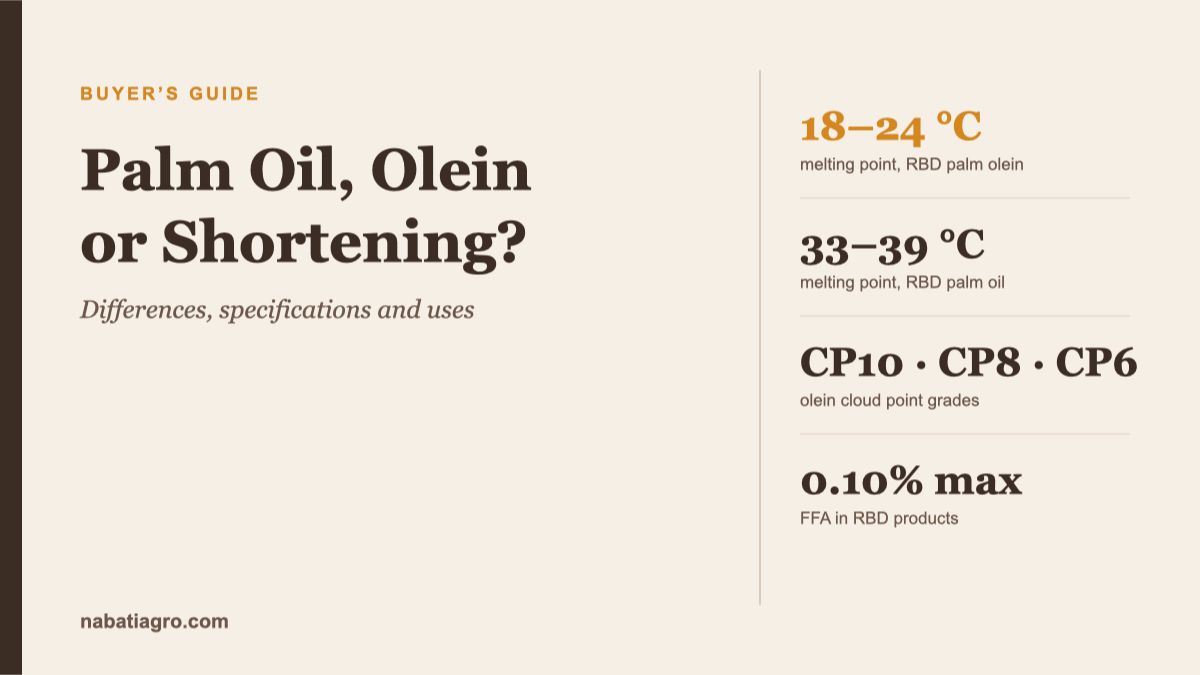
RBD palm oil, RBD palm olein and palm shortening all come from the same crude palm oil, but they behave very differently in a kitchen or a factory. Choosing the wrong one means cloudy bottles in winter, greasy fried food or cakes that do not hold their shape. This guide explains how each product is made, how they differ in specification, where each one is used and what to check when buying in bulk.
The Three Products at a Glance
| RBD Palm Oil | RBD Palm Olein | Palm Shortening | |
|---|---|---|---|
| What it is | Whole refined palm oil | Liquid fraction of refined palm oil | Solid fat made from palm oil fractions, often with palm stearin |
| Appearance at 25 °C | Semi-solid | Clear liquid | Plastic, spreadable solid |
| Typical slip melting point | 33–39 °C | 24 °C max | Depends on the formula; bakery grades are usually above 38 °C |
| Typical iodine value | 50–55 | 56 min (higher for CP8 and CP6) | Depends on the blend |
| Main uses | Margarine, industrial frying, food processing, raw material for fractionation | Cooking oil, deep frying, snack foods | Bakery, biscuits, pastry, confectionery fillings |
How They Are Made
Crude palm oil (CPO) is pressed from the fruit of the oil palm. To make it suitable for food, it is refined, bleached and deodorised (RBD): free fatty acids, colour and odour are removed. The result is RBD palm oil.
RBD palm oil can then be fractionated: it is cooled under control so that the higher-melting part crystallises. Filtering separates two fractions:
- RBD palm olein: the liquid fraction, sold as cooking and frying oil;
- RBD palm stearin: the solid fraction, used in margarine, shortening and industrial fats.
Olein can be fractionated again into super olein, which stays clear at even lower temperatures. Palm shortening is not a single fraction but a formulated product: manufacturers blend palm oil, palm stearin and sometimes other fats, and may use interesterification to reach the texture a baker needs.
Key Specifications Explained
Bulk palm products are traded on standard specifications, usually based on PORAM (Palm Oil Refiners Association of Malaysia) contracts. Typical limits for RBD palm oil and RBD palm olein are:
| Parameter | RBD Palm Oil | RBD Palm Olein | What it tells you |
|---|---|---|---|
| Free fatty acids (FFA), as palmitic | 0.10% max | 0.10% max | Freshness and refining quality |
| Moisture and impurities (M&I) | 0.10% max | 0.10% max | Cleanliness of the oil |
| Iodine value (IV) | 50–55 | 56 min | Degree of unsaturation: higher IV, more liquid |
| Slip melting point | 33–39 °C | 24 °C max | Temperature at which the fat melts |
| Colour (Lovibond) | 3 red max | 3 red max | Effect of bleaching |
These are typical market figures; the exact limits are always fixed in the sales contract.
Cloud point: CP10, CP8 and CP6 olein
The cloud point is the temperature at which olein starts to turn cloudy. It decides where the oil can be sold in clear bottles:
- CP10 (cloud point 10 °C max): the standard grade for tropical markets in Asia and Africa;
- CP8 (8 °C max): a stricter grade often requested for the Middle East and South Asia, where nights are cooler;
- CP6 and below (super olein): for cooler climates and premium retail oil.
A lower cloud point means a higher iodine value and usually a higher price, because more fractionation is needed.
Which One Should You Buy?
Choose RBD palm olein if you need a liquid oil
Olein is the right choice for retail cooking oil, restaurant and industrial deep frying, instant noodles and snack production. It is stable at frying temperatures and stays liquid in warm climates. For colder markets or clear-bottle retail, ask for CP8 or super olein.
Choose RBD palm oil if you process or reformulate
Whole RBD palm oil suits margarine and fat-blend producers, industrial fryers in hot climates and refineries that fractionate it themselves. It is semi-solid at room temperature and is usually shipped and stored heated.
Choose palm shortening for bakery and confectionery
Shortening gives structure and shortness to biscuits, cakes, pastry, bread and fillings. Bakers choose it by melting point and solid fat content: a higher melting point for laminated pastry and hot climates, a softer grade for creaming and cakes. It is trans-fat free when made from palm fractions without partial hydrogenation.
Packaging and Logistics
- Bulk: RBD palm oil and olein ship in vessel tanks or in 20′ containers with flexitanks of up to about 24,000 litres. Palm oil needs heating before discharge.
- Drums and IBCs: for smaller buyers and repacking.
- Retail and food-service packs: olein is also sold in jerrycans, PET bottles and pouches.
- Cartons: shortening is usually packed in lined cartons, typically 15 or 20 kg, and shipped in containers.
Buying Checklist
- Product and grade: RBD palm oil, olein (CP10, CP8 or lower) or shortening with the melting point you need.
- Specification: FFA, M&I, IV, melting point, cloud point and colour written into the contract.
- Packaging: flexitank, drums, jerrycans or cartons, and labelling for private label.
- Documents: certificate of analysis for each shipment, certificate of origin and, where required, halal and sustainability certificates.
- Price basis: FOB, CFR or CIF, and whether the price is fixed or linked to the market.
For the latest prices and market drivers, see our palm oil market update.
Buy Palm Oil Products from Indonesia
PT. Nabati Agro Lestari supplies RBD palm oil, RBD palm olein and palm shortening from Indonesia. Tell us the product, grade, packaging, volume and destination, and our team will prepare an offer.
Request a Quote Chat on WhatsApp
Sources: Jitaree, palm oil specification grades; study on IV of RBD palm olein and stearin (PORAM limits); review of palm stearin in food; review of palm oil in food formulation (bakery shortening). Typical values; exact specifications are agreed in each contract.